
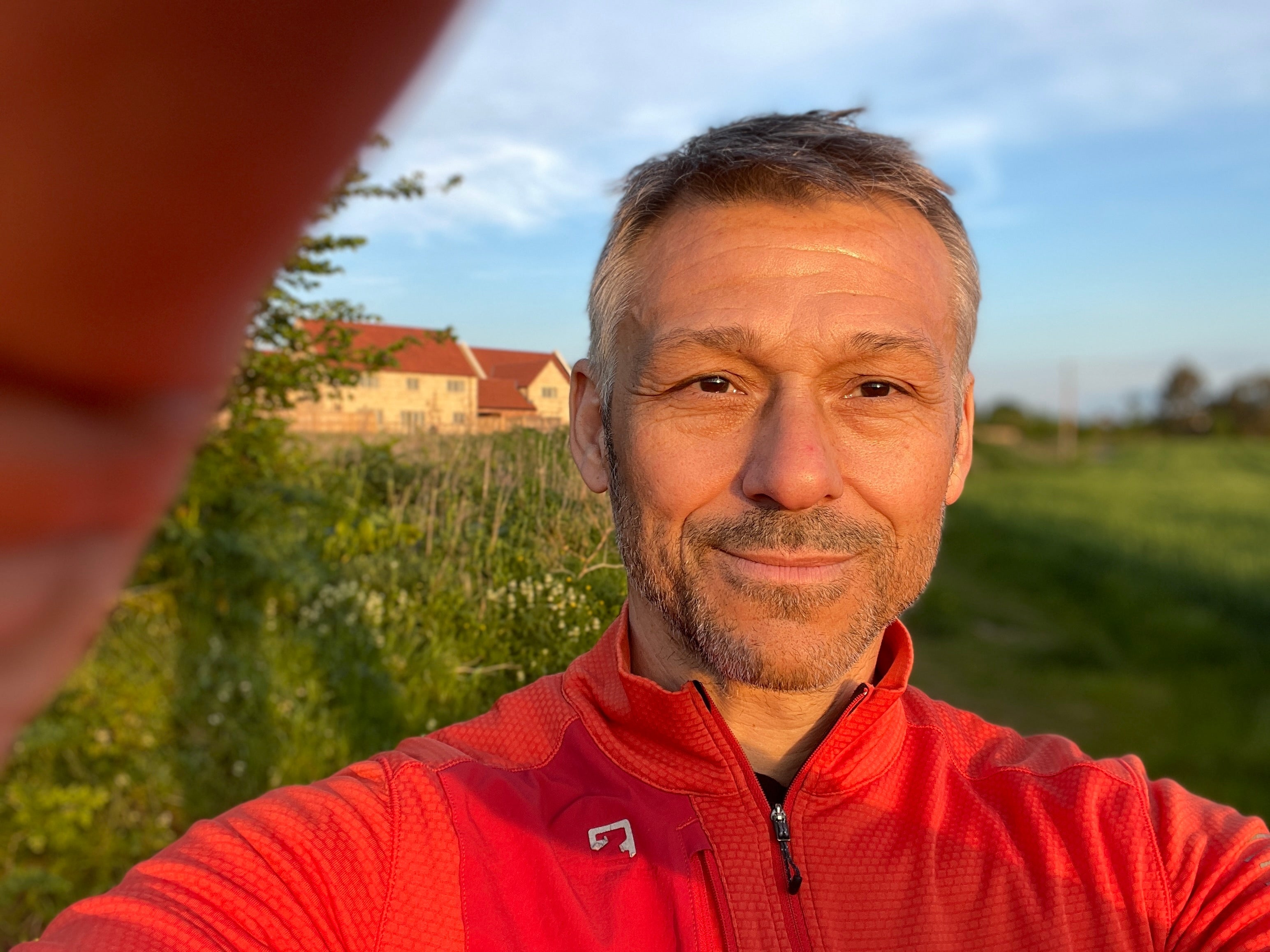
I’ve been told it’s only fair to include something about the author. I’m always slightly wary of biographies, mainly because you either miss something crucial or overshare and regret it later. So, with that in mind, and at the risk of missing something, here are just a fewof the highlights.I was born on 1 June 1968, Christened Russell Wayne Turner the middle child of three children, and I grew up in Long Hanborough, a village that felt like a small universe of freedom. My childhood home was full of music and laughter.
My mum, Marlyn, was a singer and encouraged creativity as if it were as natural as breathing. My dad was the sporty one. A former boxer. A proper all-rounder: football, cricket, tennis, swimming. He was known as “Big John” in the village, and back in Oxford where he grew up. He’d been a member of the Balliol Boys’ Club, helped run the local football side, and encouraged me, my brother, and my sister to all get involved in sport. So yes, our house had music and muddy boots. With a big extended family network nearby, it felt like a time to play, explore, and get away with a level of freedom that probably wouldn’t make it past today’s safeguarding forms. And yes, it was also full of me and my brother fighting, as brothers do.
In May 1973, just a couple of months after my sister was born, I was diagnosed with bacterial meningitis. I’d developed crippling headaches after a visit to a local swimming pool and ended up in hospital. At five years old, I didn’t understand the risk. I just loved that so many people came to see me. It was only much later, as an adult, that I realised those visits were also a chance to say goodbye.
My parents were warned I might have brain damage, hearing loss, and emotional difficulties. One doctor even suggested I might never smile again. I spent my fifth birthday in hospital. Then I went back to school after the summer holidays to a new class in a new school, carrying a story I didn’t yet understand. (My brother told me I’d been fitted with bionics, which my mum went along with, to the point I didn’t believe her when she finally admitted it wasn’t true.) Teachers often said I lived in a daydream. I’d stare into space, making shapes with my fingers. The headmaster, John Davidson, asked my mum what on earth I was doing. “Oh, he’s practising his drawing,” she told him. We lived near the Brize Norton flightpath, and I remember being asked what I was practising one day. “Concorde,” I said, as if it wasn’t obvious. Naturally, I was asked if I could draw it.So I did.Apparently that wasn’t a normal thing and it surprised a few people. None more so than Mr Davidson, who loved art and encouraged my skills at every opportunity, from tadpoles to chimney stacks to castles and the Tower of London.
Even then, it was clear I was a visual learner. I could picture things before I could explain them, and visualise performances before I could do them. That ability has followed me ever since. Painting, drawing, music, it was all there early on, but being introverted and shy meant it was hard to demonstrate. And underneath it all, there was this quiet awareness that I’d been given a chance that, a few years earlier, had been uncertain. Music became my second language. I learned the drums, briefly attempted double bass, and joined my first band at eleven with older boys from the village. After rehearsals we’d tear into Oxford in David’s Mini at ridiculous speeds, his favourite line ringing in my ears: “Don’t tell your mum.” (A sentence that could pretty much summarise every good and bad decision made in the 1980s.)
Sport mattered too: gymnastics, athletics, football, rugby. But art was always the main pull. After leaving school in 1984, I went to West Oxfordshire Technical College and spent most of my time in the art rooms: ceramics, painting, anything hands-on. The academic subjects were simply the price of entry. I even did a stint of dress-making, which taught me more about craft and structure than I realised at the time. A fellow art student, Rob Greene, introduced me to graphic design. I’d been planning to study fine art elsewhere, but I took a chance on an impromptu interview at Swindon School of Art and Design. I was accepted and allowed to skip the first stage because of my portfolio.It was there I sharpened the skills that would later define my career: graphic design, illustration, packaging, and photography, with marketing modules and design theory woven in. Things were going well. I was in a band. I was building a future.
Then life did what life does.During my second year, my dad died suddenly of a massive heart attack. I remember it was a Sunday. I’d come home to play football; he watched me score and I was so pleased. He said he didn’t feel well, but I shook his hand as I left to go back to college, the last time I saw him alive.By the time I reached my girlfriend’s house, fifteen miles away, I was told to come home. When I arrived, the family was there, aunts, uncles, everyone, and I remember hearing the words, “He’s gone.”There are moments in life that don’t feel real until years later. That was one of them.I took two weeks away from college, and when I returned, one of the course heads, Nick Hailey, a man most students considered a hard case, quietly took me aside. On a drive to a repro house, he offered support in a way I never expected, and assured me the college was there for me.
That moment mattered.There’s a saying: “When the student is ready, the teacher appears.” I’ve found that to be true, not just with formal teachers, but with unexpected ones. People who arrived at exactly the point I was finally ready to listen, and left a mark for the better. It was an early lesson that strength and kindness often arrive from the least predictable places. It also nudged me towards something I didn’t have language for at the time: self-help, emotional tools, learning how to carry grief without letting it become your whole personality. (Still a work in progress, by the way.)
After graduating, I worked briefly at Oxford University Press and then joined a local design agency, HDA, where my illustration work opened the door. I worked across varied accounts, from pharmaceuticals to automotive, and learned how real creative work happens: deadlines, decisions, compromises, and occasional moments of “Yes. That’s it.”In 1992, I co-founded The Design Syndicate. We traded until 1998, won business awards, and became members of The Prince’s Youth Business Trust, which meant meeting amazing mentors, clients, and lifelong friends along the way. We also worked with Royal Mail, creating internal and external guidelines and producing marketing collateral. Eventually we sold our client base and goodwill, and I took a year out to travel.I turned thirty on a Mexican beach, watching the sun rise over a blue sea, with the feeling that life could still be rebuilt into something bright. Sometimes you don’t need a five-year plan. You just need a reset.After travelling, I joined another agency, working on mail order catalogues and luxury brands including The White Company and Charles Tyrwhitt, as well as Berkeley Homes. During this period, I helped shape the rebrand of Choc Express into what would become Hotel Chocolat, including designing the Hotel Chocolat logo, bringing the vision to life with a talented team around me.I could see what the brand could be before it existed, the same way I once drew pictures in the air. And as my understanding of visualisation and manifesting grew, so did my clarity about brand development. At its core, it’s relationship development. Not “make it look pretty and hope for the best”. Identity. Emotion. Clarity. Direction.
Around this time, I became a dad to two incredibly talented boys, one a creative writer, the other a chef, and being a dad has shaped far more of this journey than any job title ever could. Trying to understand them properly has pushed me to understand myself better too: how we think, how we feel, how confidence is built, and what helps a person thrive rather than just cope.Over time, I began working under my own name as RWT Creative, focusing on brand development and identity design. I work with founders and organisations across multiple sectors, and I’m particularly well known for my work in aesthetic medicine, helping clinicians and clinic owners communicate their expertise with confidence, clarity, and precision.In plain English: I help good people say what they do in a way that sounds like them, feels credible, and actually builds meaningful, lasting connections.
Alongside client work, I’ve delivered workshops and spoken at industry events, and I continue to build frameworks that help people move from confusion to clarity, personally and professionally.I’ve also worked with children and young people through creative programmes, including delivering Wilde About Arts at South Hill Park for eight years, supporting ages 9 to 16, many facing challenges of their own, and I still love creating spaces where creativity becomes a form of confidence.Life kept doing what life does.Over the years I lost people who mattered deeply: my mum’s mum, “Disco Gran”, to cancer; my dad’s mum; my dad’s stepdad, the only “Grampy” I’d ever known; and in 2007, my mum, after a devastating battle with cancer.
Those losses strengthened the relationship between me, my brother, and my sister in a way I’ll always be grateful for. They also left me with a simple reminder I try not to forget: we can’t let the hardest events define us. None of us are getting out of this thing called life alive, so what matters is how we live, how we love, and what we choose to build with the time we have.I’ve always believed creativity is something we’re born with. We start curious and inventive, then somewhere along the way, many of us get trained out of it. We grow into what we think we should be, and forget what we actually are.
That’s why I’ve kept learning beyond the world of design: nutritional coaching, behaviour change coaching, mindfulness, and NLP. The more I study, the more I see the same thread running through everything: wellbeing, the mind-gut connection, visualisation, and the quiet power of creativity to shift how we think, feel, and act.Whatever life throws at us, we’re all seeking the same thing in one form or another: Clarity. Who am I? What am I doing? Why does it matter? Where am I going? In a world of nearly eight billion people, we can get pulled into comparison, scarcity, and that nagging sense of “not enough”, or we can notice the common ground we share, and move forward from there, without losing what makes us individual.
Celebrate difference as personal strengths, not as status symbols. Be present. Make better choices. Practise gratitude. Improve life not just for ourselves, but for the people around us.I’ve spent over 35 years building brands from the inside out, and learning how people build themselves in the same way. I still design, illustrate, write and teach. I climb, I ski, I train, and yes, I still spend a fair bit of time staring into space, where I doodle the next idea before it turns into something real.

Share: